
Sunday, September 9, 2007

Extra Credit- Religion Discussion

After the initial hard-to-understand announcer and then slight awkwardness in the small groups, people of different faiths and ethnicities began to interact. The purpose of the USC is to serve students, unite people, and facilitate dialogue among different faiths. At the root of its aims, the dialogue was to remove prejudice by removing ignorance and discussing differences.
I thought one key point the group made was that dialogue does not mean debate or conversion--- it simply means discussion. And, I agree that misunderstandings about different cultures or religions lead to conflict. My small group even got heated at moments. One student kept badgering a Muslim man. He kept asking why Islam spawns so many terrorists and did not listen to what the Muslim man had to say. My group consisted of John and a couple other UT students but it was largely made up of many adults and a professor. My group mainly consisted of Muslims, Catholics, Hindus, and “soul searchers.” These individuals made some very interesting and true points:
We should focus on what we have in common in order to dispel conflict. At the same time, knowing the differences and educating yourself about other religions can help strengthen your own believes. One must know other religions in order to fully understand his or her own. But religion can be used as a political institution to control people or mask problems (like a mental problem). It is power and can be used for the wrong purposes. Indeed, institutions seem to preserve differences in order to keep power consolidated (for example, middle eastern controls) . Education helps make one less vulnerable to wrong interpretation. We thought that a fear of differences is encouraged by society and experiences.
We then discussed some aspects of Islam. I learned that the Jihad that everyone hears about on TV—the religious crusades terrorists are on—actually is supposed to be an inner-struggle against sin and badness. An internal, not external, war. Islam is also supposed to be a gentle relgion. For example, at the end of the world one cannot even kill an animal or a plant. We discussed how there could be a large number of Muslim extremists because of the environment of the Middle East which seems to perpetuate brainwashing through the media and culture. I also learned that a Muslim man can marry into any religion but a Muslim woman can only marry another Muslim. I thought this very-close-to-sexist practice mirrored the male-only priesthood of Catholicism. Perhaps, remains of past hierarchies.
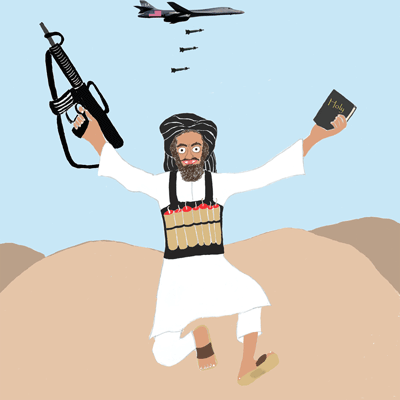


VS
Overall, it was interesting hearing and contributing my own opinions on different religion matters. I am not sure if I will continue attending the group, but it was definitely worth it and the food was tasty.

Wednesday, September 5, 2007

Denton A Cooley, M.D.

I have had many role models in my life, and I think it is difficult to pinpoint just one individual. Whether a teacher or parent or ambitious friend, I think I have modeled myself after a vast array of leaders. I like Daniel Gaolemanetal’s definition of leadership: “gifted leadership occurs where heart and head—feeling and thought—meet” (62). Seeing the topic, I reluctantly decided that I would have to brainstorm and think about my future (something often asked of college students) in order to find a role model.


My Dad and Mom


The very first person that came to my mind was my mother. Like many girls, I have idolized my mom . She went through a great deal socially and emotionally and still turned out a caring and successful person. Among her difficulties, her sister became mentally insane in the rural high school she attended, and her father died of cancer her freshman year of college. Yet, somehow, she managed to be the star of the University of Kansas track team, set a world-record, bear the torch in the 1980 Winter Olympics, attend Law school, marry my father, and raise two kids. Her cheerful demeanor has supported me in everything I do. She always has opinions about people and events around me—but not necessarily strong opinions about me. Her style of rule-making consists of dropping subtle hints rather than making definite guidelines. I could easily write a discussion about how my mom is a role model, but after reading the Texas Exes stories I realized that I can more strongly model myself after Denton A. Cooley.


Denton Cooley


Not only did but Cooley achieve amazing medical advances, but he also succeeded in every aspect of University life. Socially he was in Frat and a social organization, the Texas Cowboys. Athletically he was on the basketball team. And, of course, he had great academic success. What I admire about him, however, are his “normal” struggles. Cooley noticed that “it became necessary to budget [his] time quite severely in order to maintain [his] grade-point average” (950). One might expect such a medical genius to have had no trouble with time management, but, just like the run-of-the-mill college student… or perhaps the typical Professor Bump student, not all his college classes were a breeze. Whether it was difficultly in English composition or finding his place in a big university institution—I identify with his human struggles.


As John notes, Cooley performed the first open-heart surgery and pioneered many surgical procedures. Yet, in his autobiography, I noticed that Cooley did not focus of his medical accomplishments. This modesty makes me even more in awe. Cooley made simply amazing advances in medicine but he also excels in his personal skills.


A typical large UT class

Like Cooley, I have already sensed that the “lack of personal attention and support of individual students [at UT] impart[s] a spirit of independence and competitiveness that offset the most theoretical disadvantage of an oversized student population” (950). Indeed, on my journey here at the University of Texas I plan to model myself after Denton Cooley and attempt to find myself and succeed not only academically but also socially.